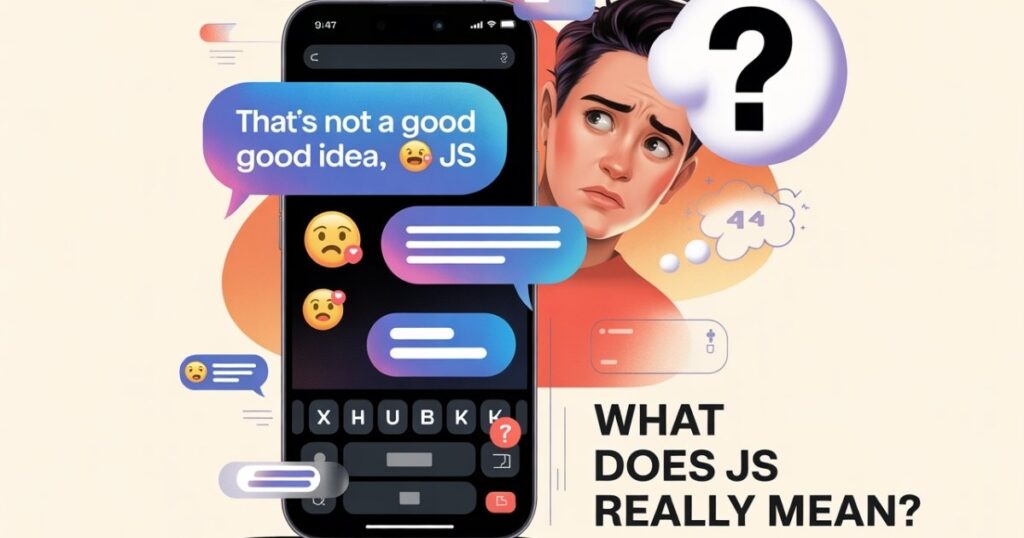
Ever stared at your phone wondering what someone really meant when they typed “JS” at the end of their text? You’re not alone. This tiny abbreviation packs more meaning than you’d expect and misunderstanding it can lead to awkward conversations or even damaged relationships.
Let’s decode what does JS mean and why context matters more than you think.
What Does “JS” Mean in Texting?
Here’s the straightforward answer: JS stands for “just saying.” This texting abbreviation lets people share opinions, observations, or criticism while maintaining plausible deniability. The js meaning in text essentially softens whatever comes before it or at least, that’s what senders hope.
You’ll spot js in texting across various contexts:
- “That shirt doesn’t match your pants, JS”
- “Your presentation had some errors, JS”
- “You’ve been on your phone all night, JS”
The js definition emerged during the early texting boom when character limits made abbreviations essential. Now it’s everywhere from casual group chats to slightly passive-aggressive family texts. Understanding the js slang meaning requires reading between the lines because the same two letters can sound helpful or hostile depending on who’s sending them.
What does js mean in your specific conversation? That depends entirely on tone and relationship dynamics.
The Nuance Behind “JS”
Here’s where things get interesting. The just saying abbreviation isn’t always innocent. Sometimes it’s genuinely helpful. Other times? It’s a digital eye-roll wrapped in two letters.
Consider these scenarios:
| Message | Likely Intent | How It Feels |
| “Your tire looks flat, JS” | Helpful observation | Genuinely caring |
| “Some people never clean up, JS” | Passive-aggressive jab | Annoying and indirect |
| “That movie was terrible, JS” | Opinion sharing | Neutral to friendly |
The js tone and context determine everything. When your best friend uses it, you probably laugh it off. When your mother-in-law texts it, you might spiral into overthinking. The js meaning in texting shifts based on relationship history, previous conversations, and even what time of day the message arrives.
Psychologically, people use js abbreviation as a shield. It lets them criticize without fully owning the criticism. “I’m just saying” as if those words magically erase accountability. This linguistic trick creates distance between the speaker and their potentially hurtful observation.
The message tone matters more than the actual words. Adding emojis changes everything. “JS 😊” feels friendly. “JS 🙄” screams judgment.
When Should You Use “JS”?
When to use js appropriately requires social intelligence and timing. The right moment for this abbreviation exists, but it’s narrower than most people think.
Good times for using js in messages:
- Sharing helpful observations with close friends
- Offering gentle reminders without sounding bossy
- Adding your opinion to casual group conversations
- Softening potentially harsh but necessary feedback
- Making suggestions without demanding immediate action
Real-world example: Your roommate leaves dishes in the sink constantly. Instead of starting World War III, you text: “Those dishes have been there since Tuesday, JS.” You’ve made your point without launching a lecture.
The key? Context in texting and relationship trust. Use js in casual conversations where people know you well enough to interpret your intentions correctly. Don’t deploy it with new acquaintances who might misread your tone completely.
Appropriate js use means gauging whether the recipient will appreciate your input or feel attacked by it. When in doubt, skip the abbreviation entirely.
✅ Polite Alternatives to “JS”
Sometimes polite alternatives to js serve your message better. These formal alternatives to js convey respect while maintaining clarity:
- “I thought I’d mention…”
- “It might be worth considering…”
- “Have you thought about…”
- “From my perspective…”
- “Perhaps you might want to…”
These respectful language options work beautifully when you’re navigating delicate situations or talking with people who deserve extra courtesy. The softening language approach prevents misunderstandings while preserving relationships.
Why use longer phrases? Because polite phrases demonstrate that you’ve put thought into your communication. You’re not just dropping a criticism and running away behind two letters.
🧑💼 Professional Alternatives to “JS”
Never and I mean never use js in texting for work emails. Your boss, clients, and colleagues need professional wording that reflects competence and maturity.
Business-appropriate options:
- “I’d like to share a thought…”
- “Based on my experience…”
- “For your consideration…”
- “I noticed that…”
- “It’s worth noting…”
The professional tone you establish through language builds credibility over time. Using texting abbreviations in workplace communications makes you look unprofessional even if everyone texts casually outside the office.
Js professional alternatives maintain authority while still allowing you to share observations or concerns. Your career reputation depends partly on how you communicate, and business tone matters in every message you send.
👋 Casual Alternatives to “JS”
For js in casual conversations, you’ve got plenty of options that match different vibes:
- “Just a thought…”
- “No offense but…”
- “Honestly…”
- “Real talk…”
- “Not gonna lie…”
- “Between us…”
These informal texting options let you match your friend group’s energy while staying authentic. The js casual use works fine among close friends, but sometimes mixing it up prevents you from sounding repetitive or annoying.
Casual slang evolves constantly, so stay aware of what sounds natural versus forced in your social circles.
How Tone Changes Everything
Here’s the truth: how tone changes texting determines whether your message lands well or explodes in your face. Identical words carry wildly different meanings based on delivery.
Punctuation examples:
- “JS.” (period = definitive, possibly harsh)
- “JS!” (exclamation = enthusiastic or sarcastic)
- “JS…” (ellipsis = trailing off, uncertain, or passive-aggressive)
Emoji impact:
- “JS 😊” reads as genuinely helpful
- “JS 😬” suggests awkward truth-telling
- “JS 🙄” screams condescension
The texting tone you create through these small choices shapes how people perceive you. Your wording impact extends far beyond the literal definition of your words.
Digital tone lacks vocal inflection, facial expressions, and body language. That’s why message interpretation goes wrong so frequently. People project their own emotions and insecurities onto your texts.
Trust your instincts about tone in communication. If something feels off when reading a message, it probably deserves clarification before you spiral into assumptions.
15 Top-Tier Ways to Reply to “JS”
Your response sets the entire conversation’s direction. Choose wisely based on relationship dynamics and what the sender likely intended.
😅 Friendly or Casual Replies
When the message feels genuinely helpful:
- “Thanks for letting me know!”
- “I appreciate the heads up”
- “Good point, hadn’t thought of that”
- “You’re probably right, honestly”
- “Fair enough!”
These responses acknowledge the input without starting drama. They work perfectly for js usage that seems well-intentioned.
😏 Sarcastic or Witty Comebacks
When you’re close enough for playful banter:
- “Thanks, Captain Obvious”
- “Oh wow, groundbreaking observation”
- “Your input has been noted”
- “Fascinating take, truly”
- “I’ll alert the media”
Use these only with friends who understand your humor. Sarcasm misreads easily in texting nuance.
😬 Defensive or Confused Responses
When something feels off:
- “What do you mean by that?”
- “I’m not sure how to take that”
- “Are you being serious right now?”
- “That came across kind of harsh”
- “Did I do something wrong?”
These responses request clarification and set boundaries. Don’t let passive-aggressive js intent slide if it genuinely bothers you.
Cultural and Generational Use of “JS”
🧒 Younger Generations (Gen Z & Millennials)
Gen Z practically invented modern texting slang, while Millennials adopted js abbreviation early in the 2000s. Younger people use what does js mean ironically sometimes adding layers of meaning that confuse older generations.
Speed drives youth communication. Efficiency matters more than formality. Js texting use fits perfectly into this fast-paced digital landscape where TikTok and Twitter shape language evolution daily.
👴 Older Generations
Baby Boomers and Gen X often prefer complete sentences. They punctuate properly and avoid texting abbreviations that might confuse recipients. Explaining js meaning to your parents requires patience and examples.
The generational gap in js communication creates frequent misunderstandings. Teaching older family members about js text slang helps bridge this divide and prevents unnecessary conflict.
When NOT to Use “JS”
🚫 Avoid “JS” in These Situations:
Professional settings: Never use js in messages for work correspondence. Your career depends on professional wording.
Serious conversations: Grief, illness, or relationship problems deserve full attention. Js usage examples show it trivializes important topics.
First impressions: Dating apps, job applications, or meeting new people require clarity over casualness.
Conflict resolution: Direct communication works infinitely better than hiding behind just saying slang.
With strangers or acquaintances: People who don’t know you well can’t interpret your js context accurately.
Legal or official matters: Documentation needs formal language. Period.
The js context rules are simple: when stakes matter, skip the abbreviation entirely.
The Power of Clear Communication
✅ Why Clarity Matters
Digital messages lack vocal tone completely. What you mean versus what others hear often diverges dramatically. The js expression creates ambiguity that damages relationships and professional reputation.
Benefits of clear communication:
- Prevents costly misunderstandings
- Builds trust through reliable messaging
- Shows respect for recipients’ time
- Protects professional credibility
- Strengthens personal relationships
Tips for better texting:
- Read messages aloud before sending
- Consider the recipient’s perspective
- Use complete sentences for important topics
- Add context to prevent confusion
- Ask questions when something seems unclear
Your word choices reflect personality and values. Js best practices include knowing when to skip it completely.
Final Thoughts
So what does js mean in your next text? It’s “just saying” but now you understand the deeper implications. The js meaning in texting carries nuance that depends on tone, relationship, and context. Professional situations need js professional alternatives while casual friends might appreciate the brevity.
Just saying abbreviation serves a purpose in modern communication, but clarity always trumps convenience. When stakes matter, choose words that eliminate ambiguity rather than create it.
The js full form might be simple, but using it wisely requires emotional intelligence and social awareness. Pay attention to js interpretation signals in your conversations. Trust your instincts about texting nuance.
Remember: using js in messages works best with people who know and trust you. Everyone else deserves the courtesy of complete, clear communication.
Have you experienced js meaning miscommunication? How do you handle passive-aggressive texts? Your approach matters because digital conversations shape real-world relationships every single day.

Hi, I’m Ricardo Jones passionate about sharing heartfelt blessings that inspire, uplift, and bring peace to everyday life. Through my writing, I aim to spread positivity and meaningful words that connect deeply with readers. Blessings are more than words; they’re a gift of hope and joy.