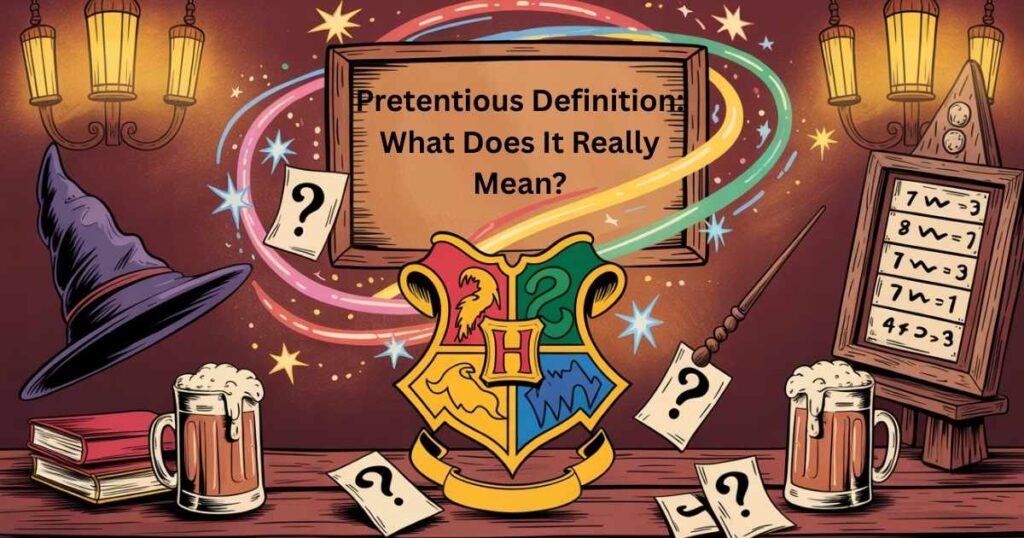
Pretentious is that sneaky little word we throw around when someone seems to be flexing a bit too hard trying to appear more sophisticated, intelligent, or cultured than they naturally are. But is it always fair? Let’s dive deep into the meaning, usage, and psychology behind it… with zero pretension, promise. 😉
What Does Pretentious Mean? The Complete Definition 📚
A short info: Breaks down the core dictionary meaning of “pretentious” as attempting to impress by affecting greater importance or merit than is actually possessed.
Real-World Example of Pretentious Behavior 🍷
A short info: Illustrates pretentiousness with relatable scenarios, like name-dropping obscure philosophers at a casual dinner to sound deep.
Etymology and Historical Context of “Pretentious” 🕰️
A short info: Explores the word’s origins from French and Latin roots meaning “claiming” or “pretending,” tracing its evolution through history.
Common Situations Where “Pretentious” Is Used 🎭
A short info: Highlights everyday contexts where the label “pretentious” gets slapped on people or things.
1. Academic and Intellectual Discussions 🧠
A short info: Using jargon-heavy language in casual debates just to seem smarter.
2. Art and Cultural Commentary 🎨
A short info: Dismissing popular works while overly praising niche, obscure ones.
3. Social Media and Online Presence 📱
A short info: Curated feeds with quotes, exotic vacations, or “deep” captions for likes.
4. Professional Settings 💼
A short info: Overloading emails or meetings with buzzwords and complex phrasing.
5. Social Gatherings 🍸
A short info: Dropping references to fine wines or classical music to elevate status.
Why “Pretentious” Can Be Problematic in Communication ⚠️
A short info: Discusses how accusing someone of pretension can shut down dialogue and create defensiveness.
The Harshness Factor 😠
A short info: The word often feels like a personal attack rather than constructive criticism.
Subjectivity Issues 🤔
A short info: What’s pretentious to one person might be genuine expertise to another.
Potential for Misunderstanding 🤝
A short info: It can mislabel enthusiasm or cultural differences as fakeness.
15 Thoughtful Alternatives to “Pretentious” 🔄
A short info: Offers kinder, more precise synonyms to describe the behavior without the sting.
1. Overly Formal 👔
A short info: Stiff language that doesn’t fit the vibe.
2. Trying Too Hard 💪
A short info: Obvious effort to impress that’s coming on strong.
3. Affected 🎩
A short info: Adopting an unnatural manner or accent.
4. Elitist 🏰
A short info: Looking down on “common” tastes.
5. Grandiose 🌟
A short info: Exaggerating importance on a epic scale.
6. Inauthentic 🙈
A short info: Not being true to one’s real self.
7. Exaggerated 🎈
A short info: Blowing things out of proportion for effect.
8. Self-Important 👑
A short info: Acting like the center of the universe.
9. Showy 🦚
A short info: Flashy displays meant to draw attention.
10. Trying to Impress 😅
A short info: Transparent attempts to wow others.
11. Too Polished ✨
A short info: Overly rehearsed perfection that feels robotic.
12. Theatrical 🎭
A short info: Dramatic flair that’s unnecessary.
13. Overwrought 🌀
A short info: Excessively elaborate or emotional.
14. Contrived 🛠️
A short info: Artificially constructed rather than natural.
15. Highfalutin 🤠
A short info: Pompous and inflated language (fun old-school term!).
How to Recognize Pretentious Behavior 🔍
A short info: Provides clues to spot when someone might be putting on airs.
Verbal Indicators 🗣️
A short info: Name-dropping, excessive jargon, or forced sophistication in speech.
Non-Verbal Signs 🙊
A short info: Exaggerated gestures, smug expressions, or flashy attire mismatches.
Contextual Clues 🌍
A short info: Behavior that shifts dramatically based on the audience.
The Psychology Behind Pretentious Behavior 🧠
A short info: Examines root causes like insecurity driving the need to appear superior.
Insecurity and Overcompensation 🛡️
A short info: Masking self-doubt with exaggerated confidence.
Social Anxiety 😰
A short info: Using “impressive” facades as a coping mechanism.
Learned Behavior 👥
A short info: Mimicking environments that reward showing off.
Perfectionism ✏️
A short info: Fear of appearing ordinary leading to over-polishing.
Practical Tips for Avoiding Pretentious Communication ✅
A short info: Actionable advice to communicate authentically without alienating others.
1. Match Your Audience 👂
A short info: Adjust complexity to who you’re talking to.
2. Prioritize Clarity 💡
A short info: Say it simply if simple works.
3. Stay Genuine ❤️
A short info: Be yourself, flaws and all.
4. Listen Actively 👂
A short info: Focus on others more than self-presentation.
5. Embrace Vulnerability 🌱
A short info: Admit when you don’t know something.
When “Pretentious” Might Be Unfair ⚖️
A short info: Cases where the label is wrongly applied to genuine traits.
Genuinely Knowledgeable 📖
A short info: Experts sharing knowledge passionately, not showing off.
Culturally Different 🌏
A short info: Norms of formality varying across cultures.
Passionate and Enthusiastic 🔥
A short info: Excitement about a topic mistaken for arrogance.
Professionally Required 🏢
A short info: Formal language required in certain roles.
The Impact of Digital Communication on Pretentious Behavior 💻
A short info: How online platforms amplify or encourage performative behavior.
Social Media Pretension 📸
A short info: Filtered lives and humblebrags for validation.
Professional Networking 🤝
A short info: LinkedIn posts laced with exaggerated achievements.
Online Learning and Discussion 💬
A short info: One-upping in forums with obscure references.
Cultural Variations in Pretentious Behavior 🌍
A short info: How perceptions of pretension differ globally.
High-Context Cultures 🏯
A short info: Indirect communication seen as polite, not evasive.
Educational Traditions 🎓
A short info: Valuing elaborate expression in some systems.
Social Hierarchies 👑
A short info: Deference displays misinterpreted as fakeness.
Regional Differences 🗺️
A short info: What’s humble in one place is boastful in another.
Building Better Communication Skills 🛠️
A short info: Long-term strategies for authentic, effective interaction.
Practice Active Listening 👂
A short info: Truly hear others to build real connections.
Develop Emotional Intelligence 😊
A short info: Read the room and respond empathetically.
Seek Feedback 🗣️
A short info: Ask trusted people if you come across as genuine.
Embrace Continuous Learning 📚
A short info: Grow without needing to broadcast it.
Value Connection Over Impression 🤗
A short info: Prioritize relationships above looking impressive.
Conclusion: Mastering the Art of Authentic Communication ✨
In the end, calling someone “pretentious” often says more about the accuser than the accused. It’s a quick, sharp judgment that can silence genuine passion or cultural difference under the guise of calling out fakery. Before reaching for the word, pause and ask: is this truly inauthentic, or just unfamiliar to me?
Authentic communication thrives on curiosity, not critique. Listen more, assume good intent, and share your true self flaws, enthusiasm, and all. When we drop the need to impress or police others’ impressions, conversations become richer and connections deeper.
Mastering this isn’t about perfection; it’s about presence. Be real, stay kind, and watch how effortlessly understanding flows. 😊

Hi, I’m Ricardo Jones passionate about sharing heartfelt blessings that inspire, uplift, and bring peace to everyday life. Through my writing, I aim to spread positivity and meaningful words that connect deeply with readers. Blessings are more than words; they’re a gift of hope and joy.