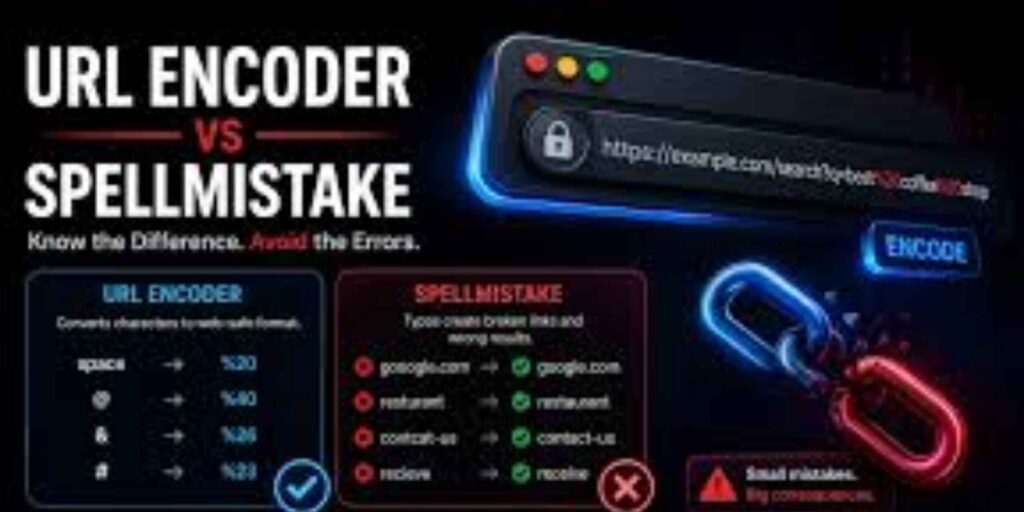
A URL encoder spell mistake may seem like a minor technical issue, but it can create serious problems for websites, web applications, APIs, and search engine visibility. When URL encoding is performed incorrectly due to spelling errors, improper character conversion, or malformed encoding sequences, browsers and servers may fail to interpret web addresses correctly. This can result in broken links, failed API requests, data corruption, and poor user experience.
Understanding URL encoding is essential for developers, SEO professionals, website administrators, and IT teams. Correct encoding ensures that special characters, spaces, symbols, and non-standard text are transmitted safely across the internet. In this guide, you will learn what a URL encoder spell mistake is, why it happens, how to identify and fix encoding errors, and the best practices used by modern web development teams to prevent future issues.
What Is a URL Encoder Spell Mistake
A URL encoder spell mistake refers to an error that occurs when characters within a URL are encoded incorrectly due to spelling errors, incorrect syntax, invalid character replacement, or misuse of encoding standards. These mistakes often appear when developers manually modify URLs or when software tools improperly process special characters.
For example, a space should typically be encoded as %20. If a developer accidentally enters %2O using the letter “O” instead of zero, the encoding becomes invalid. Similarly, misspelled parameters, improperly encoded query strings, or malformed escape sequences can prevent browsers from correctly interpreting a URL.
In web systems, these errors may seem small, but they can affect data transmission between browsers, servers, APIs, content management systems, and databases. Accurate URL encoding remains a critical requirement for reliable web communication.
Importance of Correct URL Encoding in Web Systems
Correct URL encoding ensures that information travels safely between different systems connected through the internet. Web browsers, application servers, databases, and APIs rely on standardized encoding rules to exchange data accurately. When encoding is performed correctly, special characters do not interfere with URL structure or functionality.
From an SEO perspective, proper encoding helps search engines such as Google understand page URLs and index content correctly. Improperly encoded URLs can create crawling issues, duplicate content problems, and indexing failures. Search engines may treat malformed URLs as separate resources, reducing overall website performance.
Additionally, URL encoding plays an important role in cybersecurity. Correct encoding helps prevent data corruption and reduces the risk of certain injection attacks. Many secure web frameworks automatically validate encoded URLs to ensure safe processing of user input.
Common Causes of URL Encoder Spell Mistakes
One of the most common causes of a URL encoder spell mistake is human error. Developers sometimes manually edit URLs and accidentally mistype hexadecimal values used in percent encoding. Even a single incorrect character can invalidate an entire URL component.
Software configuration issues also contribute to encoding mistakes. Different systems may use different character sets or encoding standards. If applications fail to agree on encoding rules, URLs can become corrupted during transmission. Legacy systems often encounter this problem when interacting with modern web services.
Another frequent cause involves automated tools. Content management systems, plugins, API integrations, and custom scripts may incorrectly process special characters. When encoding functions are implemented improperly or used inconsistently, malformed URLs can spread throughout an entire application.
How URL Encoding Works in Simple Terms
URL encoding is a method used to convert special characters into a format that can be safely transmitted over the internet. Certain characters such as spaces, ampersands, question marks, and symbols have special meanings within URLs. To avoid confusion, these characters are converted into encoded values.
The process uses percent encoding. A special character is replaced with a percent sign followed by its hexadecimal representation. For example, a space becomes %20, while the ampersand character becomes %26. Browsers and servers decode these values when processing requests.
Think of URL encoding as a translation system. Just as translators convert one language into another, encoding converts special characters into a standardized format understood by web technologies. This ensures consistency across browsers, operating systems, servers, and APIs.
How to Identify URL Encoder Spell Mistakes
Identifying a URL encoder spell mistake often begins with observing unusual behavior. Broken links, missing pages, failed API responses, and unexpected redirects frequently indicate encoding issues. These symptoms suggest that a browser or server cannot correctly interpret the requested URL.
Developers commonly use browser developer tools to inspect network requests. Examining request URLs can reveal malformed encoding sequences, invalid hexadecimal values, or incorrectly escaped characters. Modern browsers provide detailed error information that simplifies troubleshooting.
Log analysis also plays an important role. Web server logs, application logs, and API monitoring tools often record encoding failures. By reviewing these logs, technical teams can pinpoint exactly where the encoding process failed and identify the source of the mistake.
Step by Step Process to Fix URL Encoder Spell Mistakes
The first step is locating the affected URL. Determine which page, API endpoint, redirect rule, or application component contains the malformed encoding. Reviewing logs and testing URL behavior can help narrow the search.
Next, validate the encoded values against URL encoding standards. Verify that hexadecimal sequences are correctly formatted and that reserved characters are encoded appropriately. Many online validators and development tools can automatically detect invalid encoding patterns.
After correcting the URL, test it across multiple browsers and environments. Confirm that requests are processed successfully and that all systems interpret the URL consistently. Finally, document the issue and update development processes to reduce the chance of future encoding mistakes.
Technical Explanation of Encoding in Web Development
In web development, URL encoding follows standards defined by the Internet Engineering Task Force (IETF) and related web specifications. Percent encoding converts reserved and unsafe characters into hexadecimal representations to maintain compatibility across systems.
Programming languages such as JavaScript, Python, PHP, Java, and C# provide built-in encoding functions. Examples include encodeURIComponent(), urllib.parse.quote(), and similar utilities. These functions reduce human error by automatically applying encoding rules.
Modern frameworks including React, Angular, Node.js, ASP.NET, Django, and Laravel often handle encoding internally. However, developers must still understand the underlying concepts because incorrect manual modifications can bypass framework protections and introduce encoding problems.
Troubleshooting URL Encoding Issues in Real Systems
Real-world troubleshooting often requires examining the complete data flow. A URL may be encoded correctly in the browser but become corrupted when processed by an API gateway, reverse proxy, application server, or database integration layer.
Testing each stage independently helps isolate the problem. Developers commonly use tools such as Postman, browser developer tools, server logs, and network analyzers to compare expected versus actual URL values. This approach reveals where encoding inconsistencies occur.
Enterprise systems frequently involve multiple services exchanging data. In these environments, standardizing encoding practices across all components becomes essential. Consistent implementation reduces compatibility issues and simplifies long-term maintenance.
Best Practices to Prevent URL Encoder Spell Mistakes
The most effective prevention strategy is automation. Developers should use trusted encoding libraries rather than manually encoding URL values. Automated functions consistently apply standards and eliminate many common mistakes.
Code reviews provide another layer of protection. Reviewing URL handling logic allows teams to identify malformed encoding before software reaches production. Automated testing can further validate URL behavior under different conditions.
Organizations should also establish clear development standards. Documentation, coding guidelines, and developer training ensure that teams follow consistent encoding practices. Standardization significantly reduces the likelihood of recurring URL encoder spell mistakes.
Long Term Maintenance of URL Encoding Systems
Long-term maintenance begins with regular monitoring. Error tracking systems should continuously detect malformed URLs, failed requests, and unusual encoding patterns. Early detection prevents small issues from becoming widespread problems.
Software updates also play an important role. Frameworks, libraries, and web platforms frequently release improvements related to encoding, security, and standards compliance. Keeping systems updated helps maintain compatibility with modern web technologies.
Periodic audits can identify hidden encoding vulnerabilities. Reviewing application architecture, API integrations, and URL generation processes ensures that encoding standards remain consistent as systems evolve over time.
Final Technical Understanding of URL Encoder Spell Mistake
A URL encoder spell mistake is more than a simple typing error. It represents a failure in the process that allows web systems to exchange information accurately and securely. Even small encoding mistakes can cause broken functionality, data transmission failures, SEO issues, and user frustration.
Understanding URL encoding requires knowledge of percent encoding, reserved characters, browser behavior, server processing, and application development practices. By applying proper validation, testing, automation, and monitoring techniques, organizations can minimize encoding-related risks.
As web applications become increasingly interconnected, accurate URL encoding remains a foundational requirement for reliability, security, and performance. Technical teams that prioritize correct encoding practices create more stable systems and deliver better experiences for users.
FAQs
What is a URL encoder spell mistake?
A URL encoder spell mistake occurs when URL encoding contains invalid characters, incorrect hexadecimal values, or improperly formatted encoding sequences that prevent proper interpretation by browsers and servers.
How can I check if a URL has encoding errors?
You can inspect URLs using browser developer tools, URL validators, API testing tools, and server logs. These methods help identify malformed encoding and invalid characters.
Why does URL encoding matter for SEO?
Proper URL encoding helps search engines crawl and index pages correctly. Encoding errors can lead to duplicate URLs, crawling issues, and reduced search visibility.
Which characters should be URL encoded?
Spaces, special symbols, reserved characters, and certain non-ASCII characters should be encoded according to web standards to ensure compatibility and safe transmission.
How can developers prevent URL encoder spell mistakes?
Developers should use built-in encoding libraries, perform code reviews, implement automated testing, and follow documented URL handling standards across all systems.
Conclusion
A URL encoder spell mistake can negatively impact website functionality, API communication, search engine performance, and user experience. While these errors often originate from small typing mistakes or inconsistent encoding practices, their effects can extend across entire web systems. Understanding how URL encoding works, identifying malformed sequences, and applying standardized correction methods are essential skills for developers and technical teams. By using trusted encoding libraries, validating URLs regularly, and maintaining consistent development standards, organizations can significantly reduce encoding-related problems. Ultimately, proper URL encoding supports secure communication, reliable web performance, and long-term system stability in modern digital environments.

Hi, I’m Ricardo Jones passionate about sharing heartfelt blessings that inspire, uplift, and bring peace to everyday life. Through my writing, I aim to spread positivity and meaningful words that connect deeply with readers. Blessings are more than words; they’re a gift of hope and joy.